Disclosure: This is an independent review site. Nevertheless the owners of this website may earn commissions by referring visitors to various investment opportunities in order to meet the running costs of this website. The content on this website does not constitute financial advice. You are encouraged to talk to your financial advisor before making any investment decision.
Silver & Platinum Are Outperforming Gold in 2026 — Does That Change the Gold IRA Conversation?
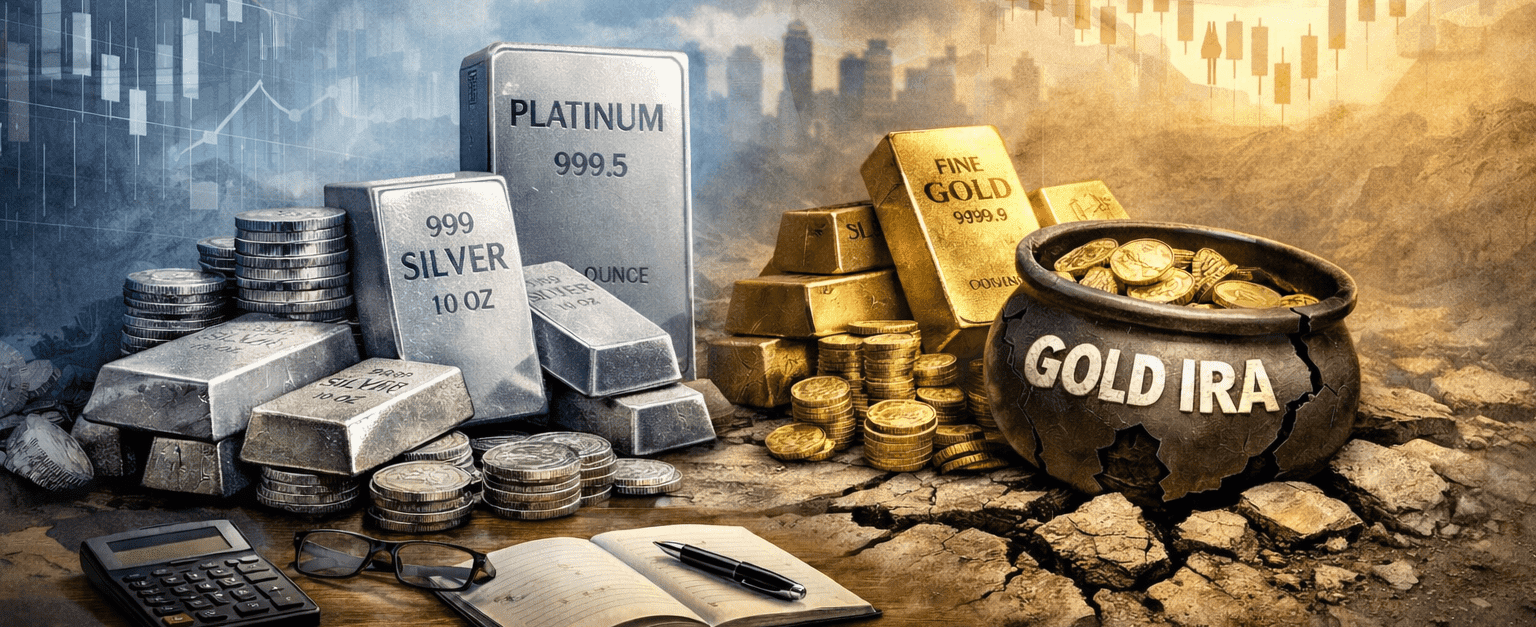
In 2026, silver and platinum have quietly outperformed gold in key stretches of the market.
While many people still focus on Gold IRAs, the conversation around precious metals IRAs continues to evolve.
The question isn’t whether gold still matters.
The question is whether it should be the only metal in the discussion.
Before making assumptions, it’s worth looking at what’s actually happening in the metals market — and how different metals behave inside retirement accounts.
A Rally Beyond Gold
In 2025, precious metals experienced notable momentum: gold moved sharply higher, while silver recorded even stronger price increases in some parts of the market. Platinum also saw significant upward movement during the same period.
These developments reflected more than short-term market activity. Several broader factors contributed to renewed attention on precious metals:
- Silver’s dual role — both as a monetary metal and an industrial resource — continued to support demand across multiple sectors.
- Platinum’s relatively limited supply and historically lower pricing relative to gold led to increased market attention.
- At the same time, gold continued to play its long-standing role within precious metals markets during periods of economic uncertainty and central bank accumulation.
Rather than focusing on short-term price movements alone, many individuals reviewing precious metals IRAs pay attention to how different metals behave under varying economic and market conditions.
What’s Driving Silver’s Strength?
Silver’s recent price movement has been influenced by several overlapping factors:
- Ongoing physical supply constraints in parts of the silver market
- Industrial demand tied to sectors such as solar energy, electronics, and renewable technologies
- Increased market activity and broader interest in precious metals during periods of economic uncertainty
At the same time, silver has historically experienced greater price volatility than gold. Because silver is influenced by both industrial demand and broader market conditions, price movements can be more pronounced during economic shifts or changes in manufacturing activity.
For individuals exploring precious metals IRAs, understanding these differences can help provide context when comparing gold and silver within a long-term retirement diversification approach.

Silver Price Volatility: A Historical Perspective
This chart is provided for historical and educational context only and should not be interpreted as a prediction of future performance.
The purpose of this chart is to illustrate how silver has experienced periods of both sharp movement and extended consolidation over time.
Understanding this historical behavior can help individuals set more realistic expectations when reviewing precious metals for long-term retirement planning.

Platinum: The Undervalued Alternative
Platinum doesn’t enjoy the same headlines as gold or silver, but that’s partly because it hasn’t dominated media coverage — not necessarily because it lacks potential.
Platinum is much scarcer and deeply tied to specific industrial sectors like automotive catalytic converters and evolving technologies. While changes in vehicle manufacturing and emissions standards can create demand variability, platinum’s underlying scarcity and its role in emerging industrial use cases continue to make it a compelling asset.
This relative pricing difference — especially compared with gold — leads some individuals to explore how different precious metals may fit within a broader retirement diversification approach.
Relevance to Retirement Planning
At this point, it’s worth stepping back and asking a practical question:
What does all this mean for someone considering a Precious Metals IRA?
Here are a few key takeaways:
1. Gold still anchors most retirement strategies
Gold remains the most widely recognized precious metal for long-term wealth preservation and risk mitigation. Its liquidity, historical prestige, and central bank demand continue to support its role in conservative retirement portfolios.
2. Silver offers higher upside potential — with higher volatility
Because of its industrial demand and smaller overall market compared with gold, silver has historically experienced more noticeable price movements. Market conditions, manufacturing activity, and broader economic trends can all influence how silver performs over time.
This higher level of volatility is one reason some individuals choose to compare gold and silver carefully when reviewing precious metals IRAs for long-term retirement planning.
3. Platinum can broaden the metals playbook
Platinum’s relatively limited supply and unique industrial demand characteristics have led some individuals to include it alongside gold and silver when reviewing precious metals IRA options.
Rather than focusing on a single metal alone, some account holders prefer a broader mix of precious metals based on their individual preferences and long-term retirement planning goals.


Gold, Silver, and Platinum in an IRA Context
It’s one thing to talk about these metals outside of a retirement structure, and another to consider them inside a Precious Metals IRA.
A Gold IRA remains straightforward: a way to hold physical gold within a tax-advantaged account.
A Silver IRA follows the same structural rules but introduces different storage considerations and volatility patterns.
Platinum can be included in some IRA structures when it meets IRS purity and eligibility standards, but its narrower market and specific industrial links make it something to evaluate carefully.
The point isn’t to pick a “winner.” It’s to understand:
How each metal behaves, why it behaves that way, and how that behavior fits your personal retirement goals.
So, Should You “Look Beyond Gold IRAs”?
Not necessarily instead of — but possibly in addition to.
A narrow focus on gold alone can overlook structural opportunities that silver and platinum are currently illuminating. That’s not investment advice — it’s context:
Silver may outperform in short bursts but carry more volatility.
Platinum could offer unique diversification potential.
Gold remains the bedrock of metals-based retirement thinking.
None of these should be the only answer, but understanding all three gives you choice with clarity, rather than assumption.
Our honest takeaway
In markets as dynamic as 2026, the value for individuals planning for retirement often comes from understanding:
Why metals move the way they do.
What that means for your risk tolerance.
How incorporation into a retirement structure changes the equation.
If precious metals are part of your planning conversation this year, broadening the lens beyond gold alone can bring clarity — not confusion — to your decision.
Learn More Before Making a Decision
If you’re still in the learning phase, taking time to review how different companies explain the process can be useful — without committing to anything yet.
This allows you to understand:
How accounts are structured
What options are available
Which approach aligns with your goals
(Educational materials only — no obligation required)