Disclosure: This is an independent review site. Nevertheless the owners of this website may earn commissions by referring visitors to various investment opportunities in order to meet the running costs of this website. The content on this website does not constitute financial advice. You are encouraged to talk to your financial advisor before making any investment decision.
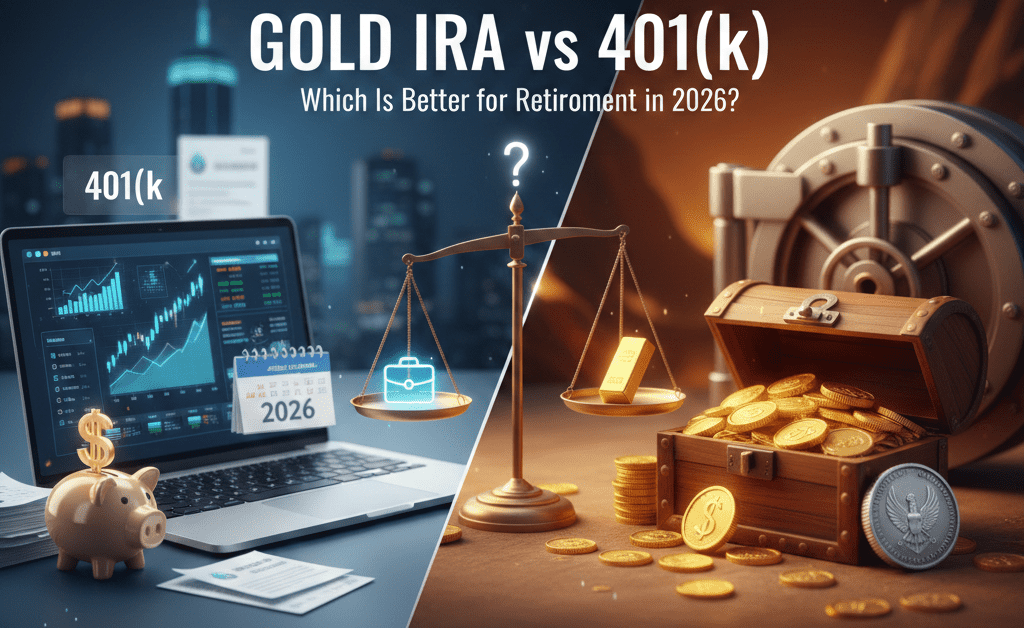
Gold IRA vs 401(k): Which Is Better for Retirement in 2026?
Planning for retirement often starts with familiar options like employer-sponsored 401(k) plans. But as market volatility, inflation concerns, and economic uncertainty continue into 2026, many investors are asking a broader question:
Is a traditional 401(k) enough—or should a Gold IRA be part of a retirement strategy?
This guide provides a clear, educational comparison of Gold IRA vs 401(k) to help you understand how each works, how they differ, and what factors may matter most before making any decisions.
What Is a 401(k)?
A 401(k) is an employer-sponsored retirement plan that allows employees to contribute a portion of their paycheck into tax-advantaged investment accounts.
Most 401(k) plans are invested in:
Mutual funds
Index funds
Stocks and bonds
Target-date funds
Contributions are typically made pre-tax (Traditional 401(k)) or after-tax (Roth 401(k)), depending on the plan.
While 401(k)s are widely used and convenient, they are generally fully exposed to the stock market, which can introduce volatility—especially close to retirement.
What Is a Gold IRA?
A Gold IRA is a type of self-directed Individual Retirement Account that allows investors to hold IRS-approved physical precious metals, such as gold and silver, instead of paper-based assets.
Unlike a standard IRA:
Assets are stored in an IRS-approved depository
Metals must meet specific purity standards
The account is administered by a specialized custodian
If you’re new to the concept, this overview of how Gold IRAs work can help clarify the basics before comparing options.
Understanding how a Gold IRA works helps clarify why it is often discussed alongside — rather than instead of — traditional retirement accounts.
Key Differences Between a Gold IRA and a 401(k)
| Feature | 401(k) | Gold IRA |
|---|---|---|
| Asset Type | Stocks, bonds, mutual funds | Physical gold & silver |
| Market Exposure | High | Lower correlation to markets |
| Inflation Hedge | Limited | Historically stronger |
| Account Control | Employer-managed | Self-directed |
| Storage | Digital / paper assets | IRS-approved depository |
| Volatility | Market-dependent | Asset-based |
Both account types follow IRS contribution and distribution rules, but the risk profiles and asset structures differ significantly.
Why this comparison is often misleading
Comparing a Gold IRA directly to a 401(k) can be useful for understanding structure, but it often leads people to the wrong conclusion. These accounts are designed for different purposes, under different assumptions. When the comparison turns into “which one is better,” it usually means the underlying question hasn’t been fully examined yet. In many cases, the real issue isn’t choosing between accounts — it’s understanding why a change is being considered at all.
Pros and Cons of a 401(k)
Advantages
Employer matching (when available)
Easy payroll deductions
Familiar investment options
Tax-deferred or tax-free growth (depending on plan)
Limitations
Heavy reliance on market performance
Limited diversification outside equities
Less flexibility in investment choices
Potential exposure to inflation risk
Pros and Cons of a Gold IRA
Advantages
-
Exposure to physical precious metals
-
Diversification away from paper assets
-
Potential hedge against inflation and currency risk
-
Long history of gold as a store of value
Considerations
-
Additional fees (custodian, storage, administration)
-
No dividends or interest
-
Requires specialized setup
-
Best suited for long-term holding strategies
Many investors choose to compare Gold IRA companies to better understand differences in education, support, and account structure before moving forward.
Which Option May Be Right for You?
A 401(k) may appeal to individuals who:
Prefer employer-sponsored simplicity
Are comfortable with market-based investments
Are earlier in their career with longer time horizons
A Gold IRA may appeal to individuals who:
Want to diversify retirement assets
Are concerned about inflation or market volatility
Prefer tangible assets alongside traditional investments
Neither option is inherently “better”—the suitability depends on goals, risk tolerance, and time horizon.
Can You Have Both a Gold IRA and a 401(k)?
Yes. Many retirees and pre-retirees choose not to replace their 401(k), but to complement it.
Using multiple retirement accounts may allow for:
Broader diversification
Reduced reliance on a single asset class
Greater flexibility over time
Understanding how each account fits into a broader strategy is often more important than choosing only one.
Final Thoughts Before Making a Decision
Choosing between a Gold IRA vs 401(k) isn’t about predicting markets—it’s about understanding structure, risk, and alignment with long-term goals.
Before taking any next steps, many investors prefer to review educational materials and learn how different options work in practice. This approach helps reduce pressure and supports informed decision-making.
For those exploring precious metals further, this Goldco review provides additional context on how one provider structures its educational process.
Learn More Before Making a Decision
If you’re still researching and want to understand how Gold and Silver IRAs are structured—without opening an account or making a purchase—you can request free informational materials that explain:
How precious metals IRAs work
What options are available
What questions to ask before moving forward
(Educational materials only — no obligation required)