Disclosure: This is an independent review site. Nevertheless the owners of this website may earn commissions by referring visitors to various investment opportunities in order to meet the running costs of this website. The content on this website does not constitute financial advice. You are encouraged to talk to your financial advisor before making any investment decision.
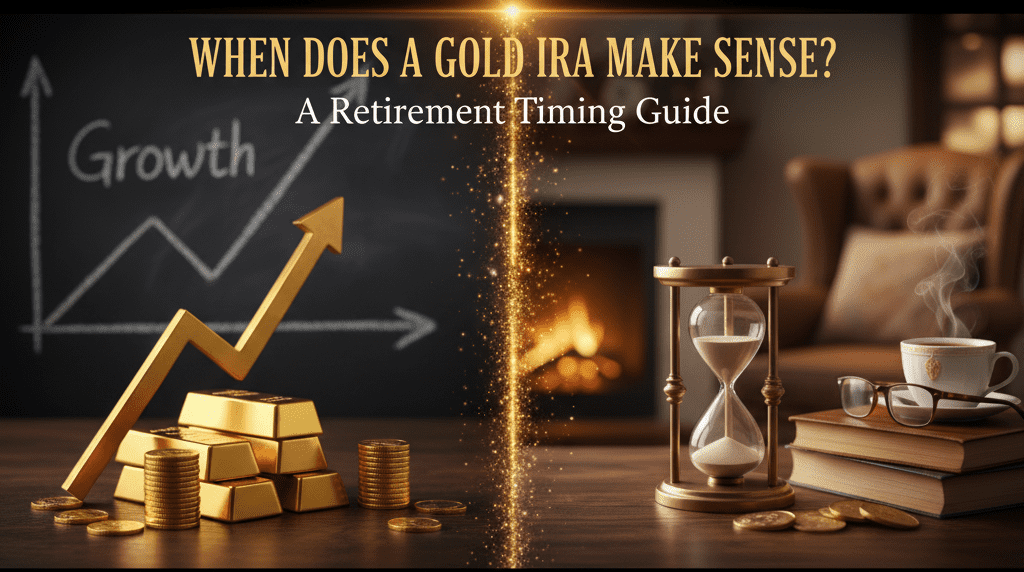
When Does a Gold IRA Make Sense? A Retirement Timing Guide
One of the most common misconceptions about Gold IRAs is that they are either “always a good idea” or “never necessary.”
In reality, the usefulness of a Gold IRA often depends less on the asset itself and more on timing, personal circumstances, and overall retirement structure.
This guide explains when a Gold IRA may make sense, when it may not, and what factors retirees should consider before making any changes.
Why Timing Matters in Retirement Decisions
Retirement planning is not static. Priorities tend to shift over time.
Earlier in a career, growth and accumulation often take priority
As retirement approaches, preservation, stability, and predictability tend to matter more
Because a Gold IRA functions differently from market-based retirement accounts, the timing of when it is added can significantly affect how useful it is.
Situations Where a Gold IRA May Make Sense
A Gold IRA is most often considered during specific phases or circumstances rather than as a default option.
Approaching Retirement
Many people begin evaluating Gold IRAs more seriously as they move closer to retirement. At this stage:
Reducing exposure to market volatility may feel more important
The focus may shift from growth to preservation
Understanding how Gold IRAs work can help determine whether they fit this stage of planning.
After Building Significant Market Exposure
Some retirees already hold most of their retirement assets in stocks, bonds, or funds.
In these cases, a Gold IRA may be explored as:
A diversification tool
A way to reduce reliance on a single asset class
This does not necessarily mean replacing traditional market-based assets, but rather creating broader retirement diversification.
During Periods of Economic or Inflation Concern
Periods of inflation, currency uncertainty, or broader economic stress often increase interest in tangible assets.
While precious metals are not guaranteed protections, some people consider them as part of a broader response to uncertainty rather than as speculative opportunities.
Situations Where a Gold IRA May Not Be Appropriate
Just as important as knowing when a Gold IRA may make sense is understanding when it may not.
Early Career or Long Time Horizons
Younger individuals with long time horizons often prioritize:
Growth-oriented assets
Compounding returns
Flexibility and liquidity
In such cases, the structure and costs of a Gold IRA may offer limited benefit.
Need for Short-Term Liquidity
Gold IRAs are designed for long-term holding.
Those who anticipate needing frequent access to funds may find:
Storage requirements restrictive
Transaction timing less flexible
Preference for High-Risk, High-Growth Strategies
Gold IRAs are typically not chosen for aggressive growth strategies.
Individuals seeking rapid appreciation or active trading may find other options more aligned with their preferences.
How Fees and Time Horizon Interact
The timing of a Gold IRA matters partly because of how fees function over time.
Gold IRAs generally involve:
Custodial fees
Storage fees
Administrative costs
These costs are often easier to justify over longer holding periods.
Understanding how fees are structured helps determine whether the timing aligns with your retirement horizon.
A Gold IRA as a Complement, Not a Replacement
A common mistake is viewing a Gold IRA as an all-or-nothing decision.
In practice, many people consider it as:
A complement to existing retirement accounts
One component within a diversified strategy
Using a Gold IRA alongside other accounts may offer balance without requiring extreme shifts.
Questions to Ask Before Moving Forward
Before deciding whether the timing is right, consider asking:
What role would a Gold IRA play in my overall plan?
How long do I expect to hold this account?
Am I seeking diversification, stability, or something else?
Do I fully understand the rules and costs involved?
Thoughtful questions often lead to better outcomes than rushed decisions.
Final Thoughts on Timing
A Gold IRA does not automatically make sense at every stage of retirement planning.
Its relevance depends on when it is considered, how it fits within existing assets, and what goals it is meant to support.
Taking time to understand these factors before acting can help ensure that any future decision is aligned with long-term priorities.
Learn More Before Making Any Decisions
Many people choose to review educational information before deciding whether a Gold IRA fits their situation.
You can explore how Gold and Silver IRAs are structured, what options exist, and what questions to ask — without opening an account or making a commitment.
(Educational materials only — no obligation required)